Exhibit E |
|
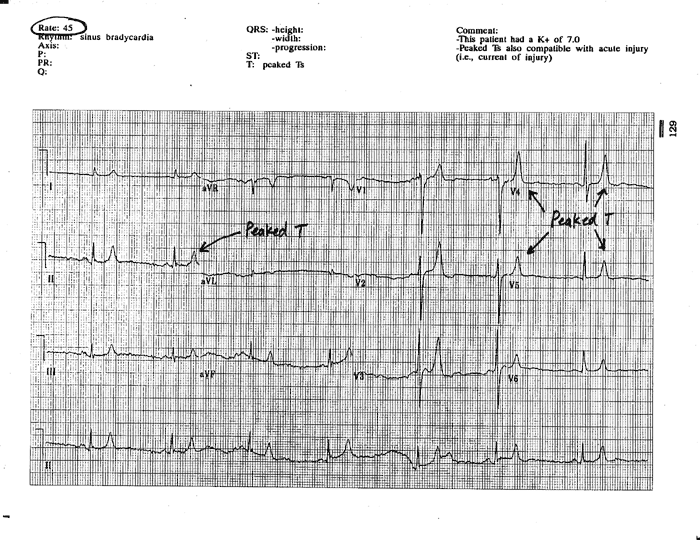
Hyperkalemia The first thing to notice is there is a sinus rhythm at a rate of 45 bts/min (see rate at top). Sinus rhythm is defined as an upright p wave in lead II and a negative p wave in lead aVR. The rate of 45 makes this a sinus bradycardia. The most notable abnormality on this ECG are the "peaked" T waves seen in all leads (but best seen in leads II, & the precordial leads (V1-6). The definition of a "peaked" T wave has been described as " a wave so peaked you could pick your teeth with it". This is an important and early sign of Hyperkalemia. In this example the patients potassium was 7 (written at top of ECG). This situation is seen frequently and may be the result of a patient undergoing therapy for heart failure including diuretics/potassium supplementation, spironolactone and ACE inhibitors plus or minus underlying renal failure. In someone with hyperkalemia they may progress to exhibit: a widened QRS, a prolonged then absent P wave, a sine wave, then asystole, none of which are shown on the present ECG. (note***The other thing to consider if you see tall T waves is that it is an early sign of acute ischemia).. Compare to Normal ECG |
 |
 Back to List
of Cases