SURVIVAL

GUIDE
2005
This version of the Survival Guide 2005 has
been altered from its original printing to comply with copyright laws and
school policies.
Letter from the Editor
First off, congratulations! This is probably the millionth time someone has said this to you since that official looking letter arrived in the mail, but think about a minute. You are in medical/dental school (pause for emphasis), and one day, you too will get to have an MD or DMD after your name. Medical and dental school is a great experience and many of the friendships you make here will last a lifetime.
Now for a few words on how to navigate this guide with a touch of efficiency, as I know your time has many demands. I’ve included a map of VGH area (see front blue page, courtesy of Amie Padilla-Thornton) since, on occasion, you will need to leave the safety of the UBC campus and venture over to say, the Nurses’ Residence or the TB auditorium. There is also a handy Book Survey that gives a quick run down of all the books, equipment, etc. and what our class thought about it. The descriptions of textbooks are in the same order as in the survey, for easy reference but for advice on dental texts and equipment, see the section on medical school as a dental student and the “Stetho-scope” equipment section (after books), respectively.
Next you will find the computer sections with a guide on using the web for learning issues, followed by how to get internet access and the in and outs of buying a computer. An abbreviated version of computer buying is in the guide, but the full monty can be found on the web at http://www.computerguide.homestead.com/ and is worth the read (you can use the computers in the anatomy lab to access it and print it, if needed).
This is followed by the “Dental section”, for dental students, by dental students and the “Parenting section”, also for parents (or soon to be ones), by parents. From here we switch pace and go to the “social” side of medical school. This part of your survival guide includes: school politics, sports, social activities, a guide to Vancouver life, and second year projects on the go.
Now that you have the run down of the survival guide, just keep in mind that, despite our best attempts to keep this biased-free, much of this based on opinion and experience. When in doubt, ask your second-year buddy or your classmates and then look at what you need or want and figure it out from there. Good luck!
Cheers!
Angela Naismith
Editor
Survival Guide 2005
Acknowledgements
I would like to acknowledge and thank the following contributors. Thank you for all your help in making the daunting task of putting together a survival guide which is informative and thorough yet readable, amusing, and brief an enjoyable effort. Without your work, this would not have been possible.
|
Michael Goodwin Trevor Hennessey Rebecca Legge Jen Manklow Stacy Miller Aneez Mohamed |
Amie Padilla-Thornton Romina Reyes Barton Thiessen Jenn Wakely Benjamin Bell |
Dana Haaf (Med 3) Jillian McDonald (Med 3) Matt Simms (Med 3) Ian Wong (Med 3) Douglas Yiu (Med 3) Travis Cadieu (Med 4) |
I would also like to thank Neil Parker and Charlene Walsh for their assistance and to Dr. Chris Loock for providing her poem, “Blame DPAS”. Finally, I would like to thank those who came before us. That is, all previous editors and writers whose hard work on past student guides has helped shape the Survival Guide for the Class of 2005. Where appropriate, I have listed past writers for contributions which have survived from one guide to the next.
Disclaimer
The Survival Guide 2004 was written, edited, and produced by the medical/dental Class of 2004. This guide in no way reflects the official opinions or policies of the UBC Faculty of Medicine, nor of the UBC Faculty of Dentistry. All opinions expressed are opinions of the Class of 2004 and should be taken to mean as such.
Editor’s Note: If you misplace your copy, an edited version will be available on Medicol. We cannot put things like “photocopy this textbook” on an official site due to copyright infringement laws.
Table of Contents
|
Navigating the Courses of UBC Medicine:
The Ins and Outs of Med 101 |
4 |
|
Textbooks for
the Tight Budget |
10 |
|
Stetho-scoop: Essentials of Equipment
Purchase |
16 |
|
The CPS (Compendium of Prime Search areas) For PBL Learning Issues (LI's) |
21 |
|
Internet Access in Medical School: The Inside Story |
24 |
|
A (not so) Quick Guide to Computer Buying |
27 |
|
The Money Pot: How to Survive the
Financial Burden of Medical/Dental School (Editor's Note: This article was partially reprinted from
the Survival Guide 2003; the banking information is current, except
for Scotia Bank which is 2 years old) |
30 |
|
Medical School as a Dental Student |
34 |
|
Parenting and Medical/Dental School |
37 |
|
Student Politics in UBC Medical School |
40 |
|
Life When the School Day Ends… |
42 |
|
The World Outside of Woodward: The Social Side of Medical School! |
43 |
|
Getting your feet wet in Vancouver! |
45 |
|
Extra-curricular projects |
47 |
|
Book survey |
48 |
"Navigating
the Courses of UBC Medicine"
(or "The
Low Down on Med 101")
-Michael
Goodwin
-adapted
from Jillian MacDonald’s article
Welcome to UBC medical / dental school! Despite the buzz of activity going on this orientation week, some of you may actually be wondering what lies in store for you academically in the ensuing weeks and months. Is med/dent school as much fun as it sounds? Do I still actually have to study with this PBL stuff? Just exactly what will I be doing in the 56 credits' worth of courses I'm enrolled in? The following is a brief rundown of all the courses you'll take during first year. The course listing is followed by the number of credits obtained for its completion. When you total up all of first year, its well above the typical 30 credits per year taken in undergrad. Fear not, it's a lot more manageable than the numbers indicate.
Orient 400 (2) Orientation to Medical/Dental School and the Professions
Short and sweet,
this week will introduce you to all you need to know about med/dent school.
Well, not really, but you will get introduced to many classmates and professors,
hear about all your courses (which doesn't make this write-up the least bit
redundant), and receive many pep talks. Do try to attend the social events, as they are a great chance to
meet the other students; and don't worry if you don't remember everyone's
name by the end of the first week (some of us are still working on this after
a full year). Also, though you may
be eager to begin your learning as a new med/dent student, try not to take
this week too seriously - there is no exam on this material and there is no
need to scramble to take notes unless you really want to.
PRIN 401 (12) Principles of Human Biology
Constituting the bulk of first term, this course will teach you the fundamentals of science which pertain to medicine. It is also meant to introduce you to PBL, and to give everyone a similar knowledge base. A wide range of topics is covered from embryology to cell biology, biochemistry to immunology, neoplasia to physiology, and pharmacology to genetics. Each week, you will have both lectures and PBL tutorials that pertain to the week's subject. Labs may or may not be related to the week's topic. This course lasts all of first term (13 weeks from Sept. to Dec.), but is divided into 3 sections so you have three different PBL groups. Depending on your background, you may find this course difficult or easy.
The material from this course is examined in a multiple choice midterm exam and a multiple choice Christmas final. Most people found the final to be more difficult than the midterm (there's a lot more material to cover, it is worth more, and it is given over 2 days). Remember that the June final does not cover any of this first-term material directly. You are also evaluated by your tutors (the faculty members leading your PBL tutorials).
A word from the wise (well, at least slightly more seasoned): Don't become so tantalized by the newness of the PBL case format that you neglect to adequately review the lecture notes through the course of the term. Although the material that emerges from the PBL cases is important, the bulk of exam material still comes from lectures so try to keep up with them. This may sound somewhat anti-PBL in philosophy, but as long as the faculty uses exams as the yardstick for learning (and uses lecture material to constitute the vast chunk of those exams) then review lectures you must. Such is the state of the present juxtaposition of the past didactic system with the new PBL system at UBC, and I guess we have to learn to live with it.
DPAS 410 (6) Doctor/Dentist, Patient, and Society
This class is really what you make it. It spans the first two years of med school and is designed to help make us more understanding and more humanitarian doctors and dentists. It has been dubbed the "Arts" course of medicine. In first year, you will be exposed to topics like population health, medical anthropology/sociology, ethics, epidemiology, evidence-based medicine, addiction, and sexual medicine. Some highlights of our year were the disability home interviews, the ethics debates, HDI skits, and the addiction and sexual medicine blocks. You will stay with your scavenger hunt buddies for all of first year (and maybe 2nd year) in DPAS, and will have them as your first PBL group of PRIN 401.
Your group of eight students (6 medical + 2 dental) will meet with your tutor each Wednesday afternoon, sometimes following a lecture. The way this course is examined varies from year to year. We had a "triple jump exam" in June (3-part exam: an in tutorial brainstorm, take home questions, and an interview based on the take home portion). Of course, you are also given marks for assignments and presentations throughout the year, and are evaluated by your tutor in December, and again in June.
The course is run by Dr. Chris Loock, who is fond of making poems to the tune of childhood rhymes. Here is an example to start off your year…
My DPAS
Shadow
By: CA Loock, MD, FRCPC, 2001
Adapted from RL Stevenson
I’ll have a little shadow that goes in and out with me,
And what will be the use of it is more than I can see.
It’s so very, very different from the basic science stream,
And I’ll see so many social issues with health care practice careen.
The hardest thing about DPAS is waiting for our experience to grow,
To fathom the core issues that patients will expect of us to know.
For sometimes it seems simple and so obvious to all,
And sometimes it gets so complex there seems to be no right answer at all.
I haven’t got a notion of how the next two years will out play,
And only a guess how these issues might present along the way.
What will I say when my patient asks me, “Hey doc, how could this be?”
Will I find a friend and mentor who’ll take time to discuss this all with me?
One morning very early, sometime before our graduation,
I’ll arise and with confidence head towards my convocation,
And my hazy DPAS shadow like a partner and a friend will cross the stage with me,
And into practice we’ll begin.
INDE 410 (6) Introductory Clinical Skills and Systems
This was one of my favorite courses, because I loved the hands-on experience. This course runs throughout first and second year. In first term, it is dubbed "Communication Skills." This section concentrates on interviewing and history-taking, especially obtaining the social history. It is here that you will become skilled in the art of "FIFE", a ubiquitous interviewing technique you will become familiar with soon enough. You will be video-taped while interviewing your peers or real patients. Groups of eight students (6 medical + 2 dental) and their tutor(s) meet one afternoon a week. Your grade will be based on tutor evaluations of your participation, assignments, and written exam questions. A lot of self-evaluation goes on as well in order to improve your interviewing skills.
Starting in second term, you will learn how to take focussed histories and do physical exams. This class tends to correlate well with the blocks, i.e., you will learn the cardiovascular exam during the cardiac block. You will stay with the same group of students for this entire course, but may have a different expert tutor for each organ-system block. Grading is based on tutor evaluations and an OSCE. The OSCE (observed structured clinical exam) is a practical exam that tests your physical exam, history-taking, and DPAS skills/knowledge in various life-like scenarios using actors as patients (4-6 stations). Some questions on the written final will pertain to clinical skills as well.
FMPR 401 (6) Family Practice Continuum
This course lasts for two years, and is taken by med students only. Once a week, you will go with a classmate to a family doctor's office (your primary tutor). During the year, you will also rotate through three other doctors' offices for one month each. These doctors are your diversity tutors. As the name implies, this allows you to get as broad an experience as possible. Many people are initially disoriented about the material covered in this course as individual experiences vary widely. Some people are minutes away from UBC while others are in White Rock (car-pool time), although they try to give the distance ones out evenly in the class. Last year, others were not even assigned to a tutor for several weeks or even months due to a shortage in tutors. You may get hands on experience right away, or you may spend most of your time observing or taking histories.
Some good advice is not to panic if you aren't learning the same things as your peers. You'll undoubtedly hear about a classmate who watches a delivery or gives his/her first flu-shot in October, while you may have been relegated to thumb twiddling at the office. Take heart, everything will eventually equalize over the four years of med school; you'll have done plenty of injections before you graduate! Enjoy the experience, and get from it what you can.
You will be graded by your primary tutors (not your diversity tutors). They will evaluate you based on completion of your patient logs, participation, attitude, etc. You will also do a few small assignments and complete a June exam (last year, this was an on-line take-home exam covering broad, common-sense principles of family practice but hang on to those lecture hand-outs).
Foundations of Medicine (FMED) Phase 2, Part 2 (P2P2)
This course starts in January and continues through second year. In a sense, it is a continuation of PRIN 401, except it focuses more on medicine itself via organ systems rather than on the science basics. FMED is divided into four blocks (each 5 weeks long) that cover a specific subject. These four blocks are: HDI, Pulm, Cardio, and FERGU (explained below). Lectures and labs are focussed on the week's subject, with one exception: there are no labs during HDI (don't get too excited -- there's far too much to do in this block even without labs).
In June, you will write comprehensive multiple-choice exams that cover all of the material from January. These exams tend to be more difficult than the December ones, and since there are no end-of-block exams or midterms, it is important to pace yourself and to keep on top of the material as you go through. Cramming everything during exam week may have worked for us in undergrad, but the material here is simply too much to leave to the end. Don’t get me wrong, you don't need to be compulsively reviewing, just don't get too far behind or you'll end up regretting it (like me). It is a good idea to do the weekly quizzes on the MEDICOL site (they are not worth any marks). In any case, they tend be a good indicator of the content and difficulty of exams.
FMED 401 (6) Host Defenses and Infection (HDI)
This block deals with microorganisms, the diseases they cause, and how the body responds to infection (including some immunology). Many students are intimidated by this block because of the large volume of information that must be learned and memorized. Your eyes WILL start to glaze over once you discover how similar all these little critters look. It is manageable if you pace yourself and do some independent learning. Some suggestions you may wish to try: fill out the microorganism tables you will be given (other students found cue cards - one for each microorganism - just as helpful), take notes on all relevant organisms in "Clinical Microbiology Made Ridiculously Simple" (BUY THIS BOOK!!!!!), and/or try to learn one major microorganism per night.
FMED 403 (6) Pulmonary System
In this block, you will learn about the normal physiology of the respiratory system, how things can go wrong (pathology), and what we can do about this. Any smokers among you will want to quit after this block, especially after you have your Pathology tutorial at VGH, where specimens are exhibited. Each week of the block builds upon the previous week's knowledge. Most blocks begin with an introduction to the physiology, anatomy, and histology of the system in question, then progress into pathophysiology and treatment.
MED 402 (6) Cardiovascular System
This is the third block, and was many people's favorite. It covers everything you might want to know about the heart and human vasculature. The cardiovascular and pulmonary systems are closely inter-linked, so you will use a lot of your knowledge from the previous block. Again, you will have an opportunity to go to the Pathology rooms at VGH. The material is interesting and logical, and the faculty (especially Dr Courneya) does a great job. Make sure to get a copy of the Lilly textbook for this section!
FMED 404 (6) Fluids, Electrolytes, and Renal/Genitourinary System (FERGU)
In FERGU, you will learn about electrolytes, the urinary system, and get an introduction to the reproductive system (especially male). This block sometimes gets short-changed as it is placed so close to exams. An upper year student told us that this is unfortunate as fluids and electrolytes will be important to us during our clerkships in the hospital in third year. But the timing of this block has a positive side too; the material is still fresh in your mind, so you don't need to re-learn it.
Histology
Histology and Anatomy lectures and labs are integrated into both PRIN 401 as well as the FMED courses. Once a week, you will sit down at your histo bench, the lights will dim, and the curtain will rise on the feature film of the day -- a pre-lab video narrated by the famous Dr. Ovalle. Following this exciting kick-start to your day, you will serenely peer into your microscopes (provided by the lab) and journey into the magical world of the microscopic. In first term, you will learn to love the basic body tissues, while in second term, you will ponder the same systems that will be covered in the blocks. You will display your knowledge in a December and June video-exam (each exam includes material from the previous term only). The best way to study for the exams by far is to watch the lab videos. However, the faculty likes to throw a few curveballs in the exams not found in those videos. For these questions, you would have needed to do some dedicated work with your histology atlas. As for the videos, someone in the class may be nice enough to arrange to have them copied.
Anatomy
Some of the best lectures you will hear all year will come from Dr Vogl's anatomy class. Be sure to bring coloured pencils and extra paper to his lectures as you "learn by drawing". Or, get a copy of Adi's notes if your drawing skills, like mine, have improved little since preschool.
The true initiation into medical school occurs only when you make the first incision into the cadaver. Some love it, some hate it, and some just get used to it. Six students work on one cadaver. Usually, there will be a lab talk beforehand (Dr. Vogl's specialty) so you will know what to do, and TA's are always willing to help a bewildered student. In first term, you will study and examine the upper limb and back. In second term, you will learn about the thorax and genitourinary systems. The best way to learn anatomy is to make the Anatomy Lab your second home and to learn the material first hand by repetition. Take your old labcoat, shoes, and your old painting clothes to the anatomy lab as the stench NEVER comes out and most items that enter the lab rarely escape being tossed or incinerated after the year is out.
You will be evaluated by a bell-ringer exam in December (first-term material) and another in June (second-term material only). You'll rotate through approximately 30 stations, and each station will have two specimens that you'll need to identify. You could be tested on bones, muscles, nerves, blood vessels, or even need to identify objects on X-rays, or CAT scans.
Physiology and Pathology Labs
These labs or tutorials occur throughout the year at VGH or in the Physiology building and are generally very helpful. This material may be examined as part of your written finals. We had some pathology specimens on our June Anatomy bell-ringer exam. As well, a physiology station or two may be included in the June bell-ringer.
One final caveat: the curriculum is in a state of constant evolution, so if our class' feedback holds any weight at all, much of what occurred last year may no longer hold true. Regardless, have fun. It's your curriculum to love, hate, or change.
-Special Thanks to Jillian MacDonald (Med III) for the adaptation of her previous year's edition of this article
Textbooks
on a Tight Budget
-Angela Naismith
In a day such as this, where about 99% of you probably have computers with internet and there are hundreds of textbooks and information websites on-line, ‘why should I bother with textbooks?’, you ask. Well, for starters, not all websites are reliable and not all the textbooks you will need are on-line. Plus, you can’t highlight the important parts of text on-line to mark it for later, and let’s face it, there is only so much time you can spend reading in front of a screen before your vision blurs and your eyes become square (hey, that’s what my mom told me!). Not to mention that those lifesaver books from the Ridiculously Simple series just aren’t on-line.
Below, is a review of some important textbooks which I hope will be fairly objective. The idea is to help you decide which to buy and which to borrow in order to save you a little of that hard earn (or borrowed) cash. Make sure you check-out the class surveys to see what our class thought of the different books. Just keep in mind: Books are only useful if you read them, or use them to prop up a table.
In order to keep this section readable, I’ll stick to the same groupings as in the survey.
GENERAL RESOURCES
Medical Dictionary: 80% say buy it, so it is a pretty good bet. Keep in mind that one is provided for your tutorials so this is for studying. There are two main ones available at the bookstore: Stedman’s Concise Medical Dictionary and Dorland’s Medical Dictionary. Either works, and it’s up to you whether you go for the full size hardcover or, where available, the cheaper but usually just as good, pocket size version.
Merck Manual: Some say buy, some say don’t bother. It is a good basic reference and explains almost all topics at a basic level. If in doubt, try the on-line manual for awhile, then decide if you want to buy or just use the internet version for free.
Harrison’s Principles of Internal Medicine: It’s big, it’s heavy but it’s thorough. This puppy is available on-line and is good for those big learning issues where you need the details. The CD-ROM is also a good option.
Toronto Notes: There are mixed feelings here, partially because, at just under $100, it’s a pretty big investment. What is it, you ask? It is a point-form guide to almost any topic you will cover in PBL, written by students that did PBL at U of T. Good for finding differential diagnosis, not so good for details and learning the basic concepts.
Robbin’s Pathologic Basis of Disease: Ahh, the cornerstone of any medical student’s library. Yes, you will need this, and it may be a bit tough getting your hands on a second-hand version because everyone tends to hang-on to it until they graduate or even longer. The title says it all. This is the book you want for looking up diseases from cancer to infections to genetic diseases.
Physiology textbooks: I’ll lump these all together since most any will do. This is a personal preference choice. If you have time, they are all available in the library and you can comparison shop. If you have an older one at home, use it and save yourself some money. These are a good first reference when you are trying to understand things like cell biology or a particular organ system.
HISTOLOGY
Most of what you will need to know for this course is in the hand-outs and videos (shown in the lab and available for viewing in the anatomy computer lab) and if need be, you can do without a textbook. There are two textbooks recommended to help you study:
Basic Histology by Junqueira: This one tended to have a lot of detail but the pictures were mostly black and white, with a lot of electron micrographs. The details in this text, although interesting and useful, are usually at a higher level than you will need.
Wheater’s Functional Histology: This is your full color guide. A bit skimpy on the details but more tissue slides than Junqueira. These pictures can come in handy while perusing your slide and you want to identify something. Just pull out your Wheater’s and check the picture to see if it is marked.
Other resources include http://www.gsm.com (mentioned in the computer resources).
ANATOMY
There are two types of books for anatomy: the dissector and the atlas. For each dissection, you will have a pre-lab talk/lecture where you will be given an overview of what to do and what to look for. Often these are given at a rapid pace so either write really fast or come prepared so it isn’t all new to you. As a class, most of us agree that an atlas is the way to go, and don’t bother with a dissector.
Grant’s Dissector: Voila, your step-by-step guide on how to dissect a cadaver. Here is one place you can save your money. Firstly, what you need to do is explained in the lecture and in the lab. Secondly, are you sure you want to touch this book, without gloves, after it has been in the lab? If you want to do some prep work, there are many copies of the hardcover version on reserve in the library.
Moore’s Anatomy: It’s defining feature is the explanations that it gives. For those of you with trouble memorizing details for the sake of memorizing, here is your salvation. This book gives you some clinical relevance to help you remember and to answer the question: “why do I have to know this?”
Netter’s Anatomy: This is the one most of the anatomy profs will refer you to because most students before you picked it. Netter is a compilation of drawings organized by body regions (eg. Upper limb, thorax, etc.). Again, go with what you need. I got Netter and barely used it.
Rohen’s Anatomy: This one’s a bit different from Moore and Netter because it uses color photographs, rather than drawings. Those who got this one say it is good for testing yourself for exams because they are more true to life than drawings. Just keep in mind, you can have the real thing in the lab and there are also photographs on-line at http://www.gsm.com.
COMMUNICATION AND CLINICAL SKILLS
The Medical Interview: Ask your buddy about possible hand-me-downs. You will only use it in first semester but you will be expected to have read the assigned readings for each week and, depending on your group, prepared to discuss them.
Bates’ Guide to Physical Exam and History Taking: Yes, you will need this, especially if you are a medical student. I know some dental students got away without buying it, since you won’t need it after 2nd year (ask your fellow dents). This is the book that tells you how to listen to a heart or check someone’s eyes. It also gives little tid-bits on what different diseases look like in the margins. This book has also been known to be helpful with certain learning issues like differential diagnoses.
Pediatric Clinical Skills: Unfortunately, you only get about two sessions where your volunteer patients are children, so unless you are set on pediatrics as your future specialty, you can get away with using the library copy for the few chapters you will need. Some pediatric basics are given in Bates’, but not nearly to the depth of this book.
PRIN 401
NMS Genetics: This book has more details than you will have time to cover in the 2 weeks of genetics you have. The one plus to this book is that it is co-authored by one of the lecturers of the two weeks, so the questions in the back of the relevant chapters are a useful study tool. I’d recommend getting this only if you are having a lot of trouble with genetics and you can find a cheap (<$8) second-hand copy.
Biochemistry text: If you still have your old biochem text, great, if not, no big deal. Basically, in the new curriculum, you will not be asked to regurgitate structures and pathways. What you need to know is provided in lectures.
Immunology text: Pretty much the same as above. If you are having trouble in week 12 and 13, there are some excellent NEJM (New England Journal of Med.) review articles that explain B and T cells more concisely than most textbooks can.
Before we are Born: This is an embryology book that takes you through the stages of development, from egg and sperm formation, all the way to when you are born. There is a great bar chart that correlates each organ’s development with its embryologic age. Just remember, when deciding whether or not to buy, you’ll probably only need this in the first week. The chart is a definite study item, though.
SECOND TERM TEXTBOOKS
No need to get these just yet, but hang on to this until second semester and pull it out again when deciding what to buy, borrow, copy or not bother with.

HDI
Clinical Microbiology Made Ridiculously Simple: Hands down the class favourite. This book teaches a large topic on an easy to follow level. It individually covers 99% of the organisms you will be expected to know, so that you don’t have to flip all around a book to find everything. Plus, the cartoons help you remember.
Medical Microbiology by Mims: This text gives you more details than the Ridiculously Simple, but you will have to flip from section to section to find it. The pros to this book are that it has pictures showing what some of the infections look like and it groups things by organ system (this can help when trying to find infectious diseases specific to your cardio or pulmonary block).
Mechanisms of Microbial Diseases by Schaechter: This book is also organized by organ systems but has become less used in recent years, mainly because of changing student preferences. The lecturers generally still referred to and reference this text, and some students swear by it. My suggestion: check them out at the library or bookstore to see if there is much difference. One benefit to this one is that Schaechter, unlike Mims, has been used by many of previous year’s students, so there are a number of second hand copies up for grabs.
PULMONARY
Most people obtained one physiology and one pathophysiology. You do not need more than one of either since they are redundant. In general, the lecture notes are thorough and the books are useful for supplementation and the more detailed learning issues. The four texts are:
Levitsky Physiology: The more favoured of the two physiology texts because it is more thorough at explaining the pulmonary physiology and the mechanisms of breathing such as ventilation and gas exchange.
Levitsky Pathophysiology: Also the more favoured choice because it is far more thorough (it is also twice as thick). I found I used this text the most of all four. This text covers material such as disease states (lung cancer, emphysema and chronic bronchitis) as well as symptoms (what makes you cough).
West Physiology: Similar to Levitsky, although some argue Levitsky is a bit easier to read and more thorough, I found it quite sufficient.
West Pathophysiology: This covers disease states but is far less detailed than Levitsky.
CARDIOLOGY
Pathophysiology of Heart Disease by Lilly: This is a must have. Most of us bucked up and bought the book, including myself, because it is so good. Although a pathophysiology book, the first chapter is the structure and function of the heart, so there is some normal physiology too. This book is written in a very readable format and each week is covered in about two chapters. The excellence of the book is probably due to the fact that it was written by a professor and a handful of medical students. You will here lecturers referring to the book a lot, so buy it.
Rapid interpretation of EKG’s: This book is set-up like a workbook. Each page covers one concept and there are 2-4 fill in the blank questions per page and future pages reinforce previously learned lessons. On average, you could probably sit down and read this book in 5-6 hours. Given that the EKG (also written ECG) week is one of the hardest of the block, this could be the answer to your prayers.
FERGU
In general, the notes for the FERGU block can stand by themselves. They are thorough, well written and cover most of the learning issues. For those harder to find learning issues, something like MD Consult or the Merck Manual will usually do. The one place where textbooks had their uses were in weeks 3 and 4. The following two texts are supplemental but not required.
Renal pathophysiology by Rose: This book has a little physiology but generally covers topics such as renal failure, metabolic acidosis and alkalosis, nephritis and so on. Although a good source of supplemental information, it’s writing is a bit awkward. Most of the class didn’t bother with this one but if you are going to use it, see if you can borrow it.
Fluids and Electrolytes Made Ridiculously Simple: I have a bit of bias here since I had this one (as did most my tutorial group after seeing how simply things were explained). This doesn’t cover the diseases specifically, but rather states of imbalances, like hyperkalemia. It explains how the body stays in balance and why, when and what happens when it does not. It also has some useful practice questions at the end of each chapter (just remember the units in this book are American, not Canadian, when you do the questions).
PARTING WORDS….
Firstly, DPAS and Family Practice were not covered in the above review sections. In DPAS, you will be given hand-outs or web site addresses for most of the material you will need. Anything extra, such as ‘An Error in Judgement’ by Speck, can be obtained from the library. As for Family Practice, there will be a series of lectures interspersed throughout the year and you will be given hand-outs for each lecture. There is no longer a textbook for this course.
Secondly, this textbook review was meant to be concise and with as little bias as possible. If in doubt, ask your buddy and/or your classmates about what they used/are using. At the beginning of every year, there is a book sale organized by the second year class. You may be able to pick up some bargains here or you may be able to get them straight from your buddy.
Finally, don’t forget the internet can be a great source of information if you have the right sources. With this in mind, we have included an internet guide to help you find the most reliable website based information.
Stetho-scoop:
Essentials of Equipment Purchase
-Dana Haaf
and Ian Wong
-updated by Rebecca Legge
Hello Class of 2005! I know that the prospect of buying equipment can be a little intimidating, but I hope that the following information provided by Dana Haaf and Ian Wong will be helpful. As the equipment rep for the Class of 2004, I can offer the following advice. Although it is not an absolute requirement to buy a diagnostic set and the vast majority of 2004 meds did not order sets at the equipment night, mid way through the year a large number of students arranged for personal orders and bought them second hand. If you are the type of person who likes to have a copy of your own textbooks as a security measure or if you know that you want to be a family doc, you will probably want to buy a diagnostic set. Also, if you are timid about sticking instruments into the orifices of patients you may want to consider owning your own and getting comfortable using the equipment on people you know. Ordering the equipment at the beginning of first year is the best time because of the price and opportunity to practice. And now for dental relevance… if you are a dental student you are not required to purchase a stethoscope, but if you would like one there are lower-cost suggestions toward the end of this article.
Diagnostic Sets
The diagnostic set usually consists of an electrically-powered handle, along with several head attachments. These could include attachments to convert the handle into an otoscope (for ears), an ophthalmoscope (for eyes), or a rhinoscope (for the nose). The handles may run using conventional batteries, or may be rechargeable, in which case a wall-plugin charger is also included with the set. The diagnostic set, in the event that you purchase one, will be the single most expensive piece of equipment you will buy. Most diagnostic sets that we were shown were listed at between $300-$500 Cdn. For the students that bought a set, the most popular seemed to be the Welch/Allyn 3.5V HPX Halogen Diagnostic set (Model #97200-SM), which listed at $489.00 Cdn.
However, a more important question is to ask whether you really need one. In the hospital, there will be wall-mounted pieces of equipment to use. In Family Practice (FMPR), your tutor doctor will certainly have the equipment. Keep this in mind and talk to your buddy.
For those interested, here's some important points about diagnostic sets:
· The first important point is power (eg. some people say that a 3.5V light is better than a 2.5V). The argument is that the brighter light makes it easier to learn on. However, both lights will suffice, except that the 3.5V increases your available range. Regardless, many upper year students state that they have gotten along just fine with the 2.5V sets. Additionally, I am told that it is unusual for one to use the stronger models at full power…simply because it can hurt, or be uncomfortable for the patient.
· Another important consideration is portability. If you don't carry it, you can't use it. Personally, the full-sized Welch-Allyn in the soft case looks very portable. With the new lithium rechargeable handle, it is significantly lighter than the older, conventional battery-type handle. Other people swear by the "pocket set" types. When looking at the overall size, remember that in third and fourth year, you will have various reference manuals, Twinkies wrappers, and other debris taking up your lab coat pocket-space as well.
· Further to the size issue, the company reps will tell you that a portable set is harder to learn with. However, there are many upper-level students and doctors who dispute this. Despite this, there are definite advantages to the full size set, especially if you plan on entering family practice. These sets will last you forever, and can be converted to wall-mount models.
· A thoughtful feature can be found on the diagnostic sets that can accept both a rechargeable handle as well as a conventional battery handle. Should you accidentally drain the rechargeable handle, just pop in the other handle and you are ready to go. In addition, should you find yourself travelling, or doing medical work in an area that doesn't accept the charger, you can still go about your business.
· Some other features to look for include: an ophthalmoscope head where the diopters setting goes up in levels of one, all the way up to ten (at least) on either side of zero. Also look for an otoscope head with an insufflator port which allows for a bulb to be attached.
· Don't worry too much about the gimmicks. The diagnostic set is, after all, just a really expensive flashlight. For example, I've been told that the rhinoscope is rarely used because the otoscope can do double duty. In addition, most doctors use the otoscope as a throat illuminator as well, so that piece is also redundant. If you still want the pieces after your initial purchase, you can buy them as accessories later.
· Finally, pay attention to the feel of the instrument (no, this isn't me getting "Artsy" with you). Try out all the models that the equipment reps will be bringing, and try out the differences in balance, weighting, access to controls, and the case supplied with the instrument.
The companies
There are two major companies that make diagnostic sets (listed below alphabetically). Both have outstanding reputations, and are sold through our distributor, BC Stevens Company.
Heine: International reputation (German manufacturing
center), award-winning optical engineering, easy to use products, unconditional
guarantee during medical school and residency, more accessories available
for future purchase. Service is offered
world-wide, maintenance-free, with a lifetime guarantee for workmanship.
Welch Allyn: Long-time name, good reputation, easy to use products,
maintenance-free, lifetime guarantee for workmanship, unconditional guarantee
during medical school and residency, found widely in North American hospitals,
more accessories available for future purchase.
Stethoscopes
|
The
stethoscope is pretty much a mandatory purchase if you are a medical
student. You'll use it during
both Clinical Skills and Family Practice for the first two years, and
it will be even more heavily used during third and fourth years in the
hospital. For that reason, you should consider your
stethoscope purchase as an investment.
As a result, in my opinion, you should |
|
really opt for the best stethoscope you can afford. The stethoscopes that you will be shown range in price from around $60-$170 Cdn. The stethoscope purchased by the majority of the class was the 3M Littman Cardiology III, which sold for $155.00 Cdn.
For the dental students, it probably doesn't make much sense to buy an expensive model, and later I'll discuss two reasonable alternatives available at the Health Sciences bookstore at VGH. Also, consult with the dental upper years to see how often you really need access to a stethoscope. It may be used occasionally in Clinical Skills, but it's likely the most important use will be for you to practice taking blood pressures. Currently, the Anatomy computer lab provides a few stethoscopes that you can use to practice.
The most well known, and arguably the best brand name, is Littman. Their products are made by 3M Canada. Other companies that make stethoscopes are Welch-Allyn, and Heine. Now, here are some points to consider:
· The most important point is the fit of the stethoscope. Everyone's ears are different, so what might feel comfortable to one person might be painful to another. Therefore, be sure to try out all the demonstration models and styles before you buy.
· Next, consider the tube length. The literature indicates that the longer the tube is, the more sound is lost traversing that distance. However, a shorter tube requires you to be significantly closer to the patient, which might be uncomfortable for either of you. This may not be relevant as they mentioned they were phasing out the shorter tubes last year.
· There are two main tube designs: the two tubes in one design vs. single lumen design. In the two tubes in one model, there are two internal tubes inside the stethoscope, one leading to your right ear, and the other to your left. In the single lumen design, the sound for both ears is carried within a single tube (one lumen) until the tube diverges to reach your ears. The sound quality is better preserved in the two tubes in one design.
· Never forget about the head, the part of the stethoscope placed on the surface to be auscultated. Traditionally, stethoscopes have come with both a diaphragm and a bell, which are more sensitive to high and low-pitched sounds respectively. Newer single-sided chest pieces combine the diaphragm and bell into a single head which you can switch between based on a difference in applied pressure.
· Depending on your professional goals, it may be worth looking at a stethoscope that supports a pediatric adapter. It may be well worth the investment now to spend a little more money for the increased versatility.
For the dental students who are interested in buying a stethoscope, a few lower cost alternatives can be found at the VGH Health Sciences bookstore. For $7.50, you can pick up a dual-head (both diaphragm and bell) single lumen stethoscope imported by Almedic (The bar code on the price sticker is 6006426 007504). I bought one to try out, and it will actually suffice for taking blood pressures. I was told by the clerk that VGH nurses will often use these as disposables if they are working around highly infectious, or immuno-compromised patients. The major disadvantage to this stethoscope is the hard plastic ear-pieces. Using it is literally a pain! Also, whipping it out when all the med students are brandishing their new $150 purchases calls for some intestinal fortitude.
A slightly pricier alternative can be had for $21.95 (Almedic code# 6006506 021956). This is a dual head, double tubed (not single lumen) stethoscope. It does everything that the cheaper model does in addition to coming with softer rubber ear tips. As well, the head is threaded, and the stethoscope is supplied with different attachments so you can customize the scope. The stethoscope comes with a pediatric bell and diaphragm, and an adult bell and diaphragm. It even comes with a bell listed as an infant's model. Again, I bought this model to test it out, and the sound seems decent; it's certainly good enough for blood pressures.
The disadvantages of this model are that the bell and the diaphragm are all made of plastic, thus making it weak. If you mishandle them, or say, leave in them in the bottom of your knapsack, it’s liable to break. A little trivia fact is that John Carter often wears the black version of this stethoscope on ER. If you look at older re-runs, many of the staff carried them slung over their shoulders. I guess they can afford the Littman stethoscopes now…
Sphygmomanometers
The sphygmomanometers (blood pressure cuffs) are an optional purchase. You will always have access to them at the hospital or during family practice. They were also supplied this year in the Anatomy Computer Lab so that students could practice with them. Most of the class did not buy a BP cuff this year, doubly so if you are a dental student. If you really want one, you could look into buying one per DPAS group, and then selling it to next year's class. The prices on BP cuffs ranges from around $55-$185 Cdn.
Tendon Hammers and Tuning Forks
|
There are two major types of tendon hammers. The first is the Queen's tendon hammer, which is a heavy weighted disc mounted to the end of a handle (like an open umbrella). The other type is the Tomahawk, a soft plastic triangle embedded in the head of the handle (the smaller and more portable option). Costs are between $2-$4 Cdn, so personal preference wins here. |
|

For tuning forks, the most important feature is to get one tuned to 256 Hz. Other frequency forks are at 128 Hz, or 512 Hz, but neither of these is really necessary. Tuning forks cost between $4-$6 Cdn. Neither tuning forks, nor tendon hammers are really needed by dental students.
Microscopes
You might have received a notice or invitation from the faculty to purchase a microscope for the first two years of study. Whether you are a dental student or a medical student, the advice is the same: do not buy a microscope. Since all the slides and the UBC microscopes are stored together in the lab, you will always have access to a microscope if you have access to the slides.
Lab Coat
Medical and dental students both share the Gross Anatomy labs, as well as several Clinical Skills sessions. You will need a long lab coat for the anatomy labs; it doesn't have to be new or pretty, because it sure won't be at the end of the year! As for Clinical Skills/Family Practice coats, the best option is to buy/borrow one from Laundry Services at VGH. They are located in the basement of Heather Pavilion, just across the street from the VGH bookstore (you might need to ask around as it's hard to find the first time). There, you can purchase a lab coat outright for $14, or rent one for the year for the same price (you have the option of keeping it afterwards). Your lab coat will be labeled as a VGH coat, and you may drop it off for free laundering at any time. Take note: medical students need short coats while dental students have long coats.
*The prices quoted are from 2000 and are therefore only approximations.
The CPS (Compendium
of Prime Search areas)
For PBL Learning
Issues (LI's)
(Especially for those who are in a bit of a rush!!)
-Aneez Mohamed
It's 3 AM and you awake from your blissful sleep with a gut-wrenching feeling of fear (not unlike the feeling you get when watching screws falling off the 1940s Playland Roller coaster during mid climb!). To your chagrin, you realize that you left tomorrow morning's LI's untouched. Well not to fear, we have compiled a list of sure-fire resources that will make you look like a rock star in tomorrow's PBL. All you need is a computer, an internet connection, and a strong cup of coffee (and perhaps a shot of gravol for that late nite computer-monitor motion sickness!). We have broken down this list into the following categories:
w Begin at the Beginning
w Tried, Tested and True
w Wild Cards
Begin at the Beginning
This is a good place to start when you have no idea what you are looking for. There are a lot of great search engine and general resources online. A word of caution: Some of these engines turn up resources that are completely bumpkis with information that is totally wrong or so out of date that you wonder how it made it on the net. So be careful with that reference from teletubbies.net on anti-arrhythmia medications. Having said that, here are some resources:
A. Engines |
||
|
Resource |
site/location (http://www.) |
Comment |
|
Altavista |
altavista.com |
Good engine. Has advanced search abilities to help revise your search. Links to a lot of Medical Schools down South and turns up good resources (often) |
|
|
google.com |
Similar to above |
|
GoTo |
goto.com |
Similar. Get a lot of layperson resources which may not be detailed enough for your LI's |
|
Lycos |
lycos.com |
Similar. Has a good spread of Canadian as well as American hits. Again, very layperson |
|
Dogpile |
dogpile.com |
Personal favorite. This is a meta-search site which means it searches over 20 search engines (including all of the ones above) and compiles the hits on one site. It is really fast and has the advantage of searching a lot of different search engines rapidly. |
B. Other |
||
|
Resource |
site/location (http://www.) |
Comment |
|
Scientific American Journals |
Medical Reference Section of Woodward Library |
Beautiful review articles on virtually every area in medicine.
Available in big black binders in the Medicine Reference area of Woodward
library (ask librarian). Also available online but not cheap!! |
|
Merck Manual |
merck.com or Resource Section of Woodward lib. |
Good place to start. Simple and concise. However, be careful because some tutors aren't too pleased with the conciseness and simplicity of the Merck Manual. The online site allows you to use the 2001 Merck Manual. |
Tried,
Tested and True
These sites and resources often answer >80% of your LI's and at 3AM are a sight for blood-shot eyes! Enjoy:
|
Resource |
Site/Location (http://www.) |
Comment |
|
MD Consult |
Available for free through UBC Library (library.ubc.ca) under Indexes and Data Bases. Open the Generic Edition. |
Absolute money!! Has hundreds of current key medical
books (like Robbin's Pathology
and Cecil's Textbook of Medicine)
as well as thousands of articles (often with full articles available)
and links to Medline, etc. This
site is designed for the 3 AM UBC PBL student!! Only gripes
are that some of the textbooks on MD Consult don't offer their figures
and that UBC only has a limited number of accounts so you may not be
able to get on (likely not a problem at 3 AM however!).
|
|
Doc Guide |
docguide.com |
Very good site. Requires registration (but free).
Has current articles and great reviews written by experts in the field.
Links to other good resources (like the National
Institute of Health). Book supply is meager in comparison to MD
Consult but there are some present. |
|
Gold Standard Multimedia (GSM) |
gsm.com (click under the Integrated Medical Curriculum) |
Again, like the above two, has a good selection of
journal articles and expert reviews. Links are pretty good too. Hold
on to this resource come Anatomy/Histology
lab reviews. There is a virtual reality quiz in anatomy/ histology
that allows you to test yourself on thousands of real pictures. Where
else can you see 800+ pictures of the Brachial Plexus? |
|
Harrison's Principles & Practices of Internal
Medicine |
Available through Harrison's online at library.ubc.ca under Indexes and Data Bases |
Great book. Can be a tough first read but you rarely
will need more information than this Internal Med Bible. Also available
in two blue 40 kg books at the Resource
Section of Woodward Lib. |
|
New England Journal of Medicine online Journals |
Available online at library.ubc.ca under ejournals |
Good review articles and the website is current.
Can obtain and print out full text articles and you look pretty prostar
if you can pull out a NEJM reference. In addition, the articles are
written to lay science person level so they are understandable. |
Wild Cards
Sometimes you get that LI that just doesn't seem to fit into the above resources. Well don't fear, we got you covered with the following resources (who loves you baby??)
|
Resource |
Site/Location http://www. |
Comment |
|
Ask Geeves |
askgeeves.com |
Don't Laugh! Geeves has saved me more times than once. You can ask your LI in the form of a question and prepare to be amazed. Geeves can also answer questions like "What is the Meaning to Life?" and "Who is Buck Jones?" |
|
Society and Medicine |
Available under Online Resources at library.ubc.ca |
Good for those psychosocial questions. |
|
Maxim magazine for Men |
maximonline.com |
We found a great picture for our Schistosomiasis article for HDI in term 2 and hey, where else can you learn life skills like how to get out of a Mexican Jail? |
So hopefully this list will give you a fighting chance against those late night PBL battles. Have fun and happy hunting!!
Internet Access in Medical School: The Inside Story
-Matt
Simms
-updated by Angela
Naismith
By the time you’re reading
this article, you’ve probably realized how important internet access will
be in your daily life during the next 4 years as a medical/dental student.
Although you will have access to the Anatomy Learning Centre computers on
campus, you will need to be online after hours.
|
Email access will be essential for:
·
communicating with the medical/dental office
·
participating in the med/dent email listserver
·
communicating with other students/faculty
·
keeping in contact with family/friends
|
Web access will be essential for:
·
taking practice quizzes
·
taking family practice exams
·
research learning issues for PBL tutorials
·
supplementing study
|
But what type of access should I get?
There are two main types of internet access: Dial-Up and High Speed.
1) DIAL-UP ACCESS
·
Advantages
Dial-Up access is conducted over a regular telephone line via a modem. This service is easy to subscribe to-often right when you call them! Although you can pay monthly fees ($9.99-$26.99) for access, you can now buy a CD from the post office (3web) for $9.95 that gives you free access after the initial CD purchase when you live in a major city, such as Vancouver and its surrounding 604 area code. Other CD’s may exist, this is just one I’ve (Angela) tried.
· Limitations
At present, regular telephone lines are limited to a speed of 56 kbps. At this speed, a telephone modem (around $40) can handle both email and basic web access, however, it takes a while for more complicated web pages to load. You will especially notice a difference when trying to search for information or taking anatomy quizzes, which often use large picture files. In addition to this, you might have difficulty operating more than one web window at a time as the speed is cut in half.
Another important limitation with dial-up access is that you are unable to talk on the phone/receive calls while using the internet. If you live at home or have roommates, they will not be appreciative of having the phone line occupied for hours at a time while you use the internet! There are, however, 2 options to help overcome this problem:
a) Internet call waiting: Tells you when someone calls ( but still doesn’t allow simultaneous use)
b) Purchase 2nd phone line: Allows simultaneous use but adds $27 to your monthly phone bill.
If you have money to burn and go the monthly plan route, it is important to know that some companies require you to subscribe to their long distance plans in order to get their advertised internet access rate. Consult the table below for representative prices and features.
2) HIGH SPEED ACCESS
With more and more developers incorporating animation and graphics into their web pages, people are turning to high speed access. This type of access is carried over two forms: either via cable (yes, the same cable as your TV!) or via a special digital telephone line called ADSL (Asynchronous Digital Subscriber Line).
· Advantages
SPEED! Yes…blistering speed! Pages load almost instantly which cuts your surfing time to only a fraction of dial-up. Not to mention unlimited, instant-on access! Cable access, previously the fastest method of consumer internet access, is now pretty much matched by ADSL because many Cable Hubs are crowded. While the speed (cable) can vary depending on internet traffic or by the number of other web surfers on your cable local network, with ADSL, you have a dedicated line (not-shared) and as a result, the speed of connection is more constant, however not as fast as peak cable access speeds. For access speeds, please consult the table below.
No 2nd phone line: Can talk and surf at the same time. Especially useful when consulting with other students over a topic on the web. And NO more busy signals! Cable access has nothing to do with the phone while ADSL’s digital fibre optic line has enough room to carry voice signals as well as data.
Multi-PC: Sharing a high speed internet connection might be an advantage for you. Roommates can split the monthly cost when running two computers off the same high speed line! By spending $50 for a network hub and some cables, more than one computer can be surfing the net with barely a perceptible drop in speed! Further to that, if you refer a new user to Rogers @ Home, you will receive one month free ($40 credit).
·
Limitations
Cost: Cost for a high speed line (ADSL or cable) is $39.95 per month, which is substantially more than dial-up access. However, if you were to add a 2nd phone line to a dial-up account, the total cost is nearly the same! …not to mention that the dial-up speed remains the same (56 kbps)!
Installation: It is important to know that, depending where you live, there might be a large waiting list for high speed installation. This is mainly due to the limited number of qualified technicians available to install the necessary components amidst the high demand for this service. In response to this shortage, both ADSL and cable companies have special “self-installation” packages which eliminate the wait and often at a REDUCED rate to those quoted below!
Availability: Another limitation to high speed service is availability. Some areas in the lower mainland are not yet equipped with the necessary digital infrastructure to deliver high speed internet. Fortunately, this is changing on a month to month basis. To find out if the digital lines have been laid in your area, go to the website or call either high speed provider.
Network Card Needed: It will also be necessary to purchase a network card ($30) which enables the computer to connect to the high speed modem which is provided with the service (incidentally these modems retail between $200-300!)
As you can tell by my article, I am a big fan of high speed access. Whether you choose dial-up access, cable or ADSL, you will have to determine which features are important to you and consult the table to see which service meets your needs. A comparison table is located on the next page. If you have any questions, feel free to email me (Matt) at msimms@interchange.ubc.ca . I’ve included a summary table of some of the internet service providers available as well as their key features.
Summary table of Local Internet Providers
|
|
Telus.net (High speed
ADSL) |
Rogers @ Home
(High speed
cable) |
Sprint Canada (dial-up) |
Telus.net (dial-up) |
|
Cost/ month |
$39.95 (modem incl.) $50 installation |
$39.95 (modem incl.) $~50 installation +$10 for non- cable subscribers |
$24.95
with Sprint LD $26.95 without |
$9.95 occasional use $24.95 frequent use $20.75 w/ Telus LD |
|
Access time |
Unlimited |
Unlimited |
Unlimited |
10hrs occasional 60hrs frequent 100 hrs w/ Telus LD |
|
Extra supplies needed |
Ethernet card |
Ethernet card |
56k modem (v.90) |
56k modem (v.90) |
|
Connection speed |
1.5 Mbps |
up to 3 Mbps (limited by traffic) |
limited to 56 Kbps (limited by phone line) |
limited to 56 Kbps (limited by line) |
|
Phone while on the web? |
YES |
YES |
NO (need 2nd line) |
NO (need 2nd line) |
|
Email addresses |
Three |
Five |
Five |
one |
|
Web page space |
5 MB |
25 MB |
16 MB |
5 MB |
|
Web address |
www. Telus.com |
Www. sprint.ca |
www. telus.com |
|
|
Phone numbers |
310-4646 |
1-888-288-HOME |
1-888-812-EASY |
310-4646 |
Note: The previously mentioned 3web internet access is $9.95 for the CD, no monthly fees, unlimited use, a modem is needed and it is limited by the phone line for speed. For details, see www.3isfree.com or call 1-877-358-3WEB for more information.
An Appended
Guide to Computer Buying
-Trevor Hennessey
Hello. As I have gotten a bit of a reputation for being the class techno weenie, I have been asked to update the intro to computer buying guide. Unfortunately, although the end product was extremely thorough, it was also 20 pages long! Apparently this was more than all the other portions of the guide combined and would have cost a fortune to photocopy and would kill a bunch of trees in the process so what I am going to do is post the entire guide online where you can view it (in the UBC computer labs if you don’t have a computer yet) and simply explain here where I feel that you should go to buy a computer and then give you two recommended systems that I have researched and should suit your needs.
The full guide available online explains how to assess your own needs, describes each component from CPU to Monitor to Hard-drive and everything in between in detail (what to look for, my recommendations along with prices) and also includes a Laptop buying guide.
The online guide can be found at:
http://www.computerguide.homestead.com
If you are thinking about buying your first computer or upgrading your current system, I would really recommend taking a look. My goal is to SAVE YOU MONEY. Education will save you from unscrupulous salesmen. Be informed.
Sincerely,
Trevor
Where
to buy
I will admit my bias right from the start, I really dislike the major retailers as they charge too much and offer too little. I went into Office Depot recently to research for this article and was really disappointed with what they offered. I mean, who would want a computer with a 13” monitor with a screen that looks like you are looking through a fishbowl? Please, PLEASE check out a local computer shop.
If you are concerned that DELL or Compaq is a better “Name Brand”, I would counter that in my experience, if it hasn’t broken in a year it’s not going to break until it wears out of normal old age (Cheap monitors are the exception here). Many of your computer components such as hard-drives, come with their own free company warranty so not having a 3 year warranty is not such a big deal. The big guys are looking for maximum profit margin. Dell, Compaq, ect, all have access to the same components as your local computer shop but they chose what brand of components to put in your computer. One 20 gigabyte hard drive is not necessarily the same as another. Pick a reputable local shop (NOT a major chain like Future Shop, Radio Shack, Office Depot, their profit margins are too high unless you are looking for a laptop but I will talk about that later). At a local shop, if something goes wrong you take it back to the shop and they fix it then and there. At the major chains you have to mail your computer in and go without until they fix it. (Buy an E-machine and if something goes wrong you have to mail it to California and wait a month and a half for them to get around to fixing it. This happened to a friend here in our class).
I myself can really only recommend one shop as it is the only one I have done business with. That shop is ATIC computers on Broadway near MEC (also online at www.atic.ca). They have been around for a long time and between myself and my family we have bought 8 computers (starting with an old 286) from them over the past 10 years and have never had a problem. In fact, my brothers 5 year old Pentium 200 is still running strong (albeit slowly). They even have an agreement with UBC to offer special deals to UBC faculty and students so that is where I would start looking. I have also had Generic Computers on Broadway recommended to me but I have had no personal experience with them and don’t know if they are competitive. All my prices for the two recommended systems below were taken from ATIC.
P.S. I am not affiliated in any way with ATIC Computers, I’m just a satisfied customer.
Two recommended
systems
|
|
Bargin System |
Hot Rod system |
|
Motherboard: |
ASUS A7V-E/WA KT133 AGP4X ATA100 w/Audio (Duron/Tbird) |
Abit KT7A-R KT133A AGP4X ATA100/RAID (Duron/Tbird) |
|
CPU: |
AMD Duron 750mhz, PC100, S462 |
AMD Tbird 1.33ghz/256k, PC266, S462 |
|
Memory: |
128MB SDRAM PC133 |
256M DDR-SDRAM PC2100/266 ECC |
|
Floppy A: |
1.44MB 3.5" Floppy |
1.44MB 3.5" Floppy |
|
Controller: |
IDE and USB, Parallel, Serial ports default Onboard |
IDE and USB, Parallel, Serial ports default Onboard |
|
HardDrive: |
IBM 20G 7200 UIDE ATA100 |
IBM 40G 7200 UIDE ATA100 |
|
Video Card: |
ATI Xpert2000 32 Mb |
Leadtech Geforce II MX-DH Pro with video out |
|
Monitor: |
Samsung 753DF 17" 0.25mm Flat-CRT |
Samsung 950P 19" 0.26mm CRT |
|
Case: |
ATIC ATX-18" w/ 250W PS |
23” ATX-tower case w/300W CSA approved |
|
Keyboard: |
104K Win95 Keyboard |
104K Win95 Keyboard |
|
Mouse: |
MS Intellimouse Optical |
MS Intellimouse Optical |
|
Modem: |
Rockwell/Connexant 56K Voice/Fax Modem PCI |
Rockwell/Connexant 56K Voice/Fax Modem PCI |
|
CD-ROM: |
Hitachi/IBM 12X/40X DVD-ROM w/software |
Hitachi/IBM 12X/40X DVD-ROM w/software |
|
Sound Card: |
OnBoard Audio (CT5880/CMedia/AC'97) |
Creative Sound Blaster Live! Value 5.1 |
|
CD-Titles: |
No |
No |
|
Speakers: |
100+W Stereo Speakers |
Chose what you like |
|
TapeDrive: |
None |
None |
|
CD-RW Drive: |
No |
Panasonic 8x4x32x EIDE |
|
Printer: |
No |
No |
|
Network Card: |
No |
No |
|
Operating System: |
Microsoft Windows Millenium Edition (ME) (OEM) |
Microsoft Windows 2000 Pro (OEM) |
|
Scanner |
No |
No |
The Bargin System
Total price: Approximately $1080. $950 without an operating system.
This is a great bargain system that you should be very happy with. This computer will be fantastic for word processing and surfing the net and will also handle the newest games quite decently. I consider that corners were cut on only one component. You could upgrade the Monitor but again, that would cost you an additional $100 and I just don’t know if it is worth the money. As I said, I think this is a great package and if you start spending $35 here and $100 dollars there, the price climbs quickly.
The Hot Rod system
Total price: Approximately $1802. $1602 if you have you own copy of Windows. Note: this is without speakers.
This is a very, very nice system. I would say that it would handle any of the new games extremely well AND outperform a Intel PIII or P4 system that would cost you more money. Don’t listen to the marketing, AMD has blown Intel out of the water with regards to both price and performance. I went with Windows 2000 for its much greater stability than either Win98 or WinME. It is a RAID system which means you can hook up two hard-drives and the computer will see only one BIG drive allowing for super fast data transfer. For your Dolby 5.1 surround sound you should pick the speakers you like the best. For the video card you could go with an ATI Radon for Video in/Video out, built in TV tuner and the best DVD playback but this is a VERY nice card for half the price and even supports dual monitors. Finally you could go with a faster CD burner but do you really care if it takes you 8 min instead of 4 min to burn a CD? All in all, I think that this system has the best Price:performance ratio and would kick some serious butt.
PS: If you already have a copy of Win98 or WinME or Win2000 kicking around, use that and save $200. Also, I did not include an Ethernet Card as they are provided free when you sign up for high speed internet.

The Money Pot: How To Survive
The Financial Burden of Medical/Dental
School
(Editor's
Note: This article was reprinted;
the information for banks is current except for Scotia Bank which is 2 years
old)
-Travis Cadieu, Med
4
-updated by Angela Naismith
Congratulations, you finally made it
into medical/dental school. You’re
about to realize a dream you’ve been following for many years. Now, all you have to do is pay the first installment
on your tuition fees. And if you’re
a dental student, you have to spend some serious dough for those instruments
you never get to take home. And regardless
of who you are, there are textbooks to buy, rent to pay in this rental hell
known as Vancouver... How are you ever going to make it?
Well, if you’re living at home and
off the milk and honey of the elders, move on to the next section. This section is for those faced with financing
themselves through school. This section
of the survival guide will tell you all about the many sources of money.
If you play your cards right and don’t go too ballistic on the textbook
buying, etc., you will make it through this year without Ivan the collecting
agent busting your limbs for cash.
Follow The Rainbow To
Brock Hall
When you start classes at UBC, if you
look hard enough you’ll see a rainbow streaking across the campus. This rainbow, like all other ones, ends with
a nice, sweet pot of gold. This pot
of gold is Financial Aid and Awards at Brock Hall. What can this place do for you?
1. Student loans: Chances
are you’ve already made an application for a student loan. The typical medical student is entitled to
a certain amount of cash from the government, which is based on tuition fees
and on the painfully long time we’re in school for the year. On average, if you are successful at receiving
the maximum amount for your student loan, you should receive around $11,000
for the year. If you received less
than this, you need to seriously examine where you were cut short for funds.
Did you state that you’d save $2,000 from your summer job?
Did you really save all of that money?
Maybe you got some cash from your folks and claimed that. If you feel that you may need more money from the government, you
may be able to gripe about this to the student loan centre (some students
received more money by giving a sob story, but these students did not already
max out on their student loan).
2. General Bursary Program: The
next major source of cash available to all students is the General Bursary
Program. But hold on, let me qualify
this. To be in the select crowd of
beggars, you must have applied and received a government student loan AND
you must have received the maximum on your student loan. For example, if all you received on your student
loan was $9,000, chances are you will not be eligible to receive general bursaries.
You see why I was stressing to you to max out on your student loan? Yes, I acknowledge the system works in strange ways. By the way, if you’re fortunate enough, you
can expect to receive anywhere from $800-$4400 in general bursaries, all thanks
to a huge list of contributors. God
bless UBC!! The deadline to apply
for this is October 1st. Application
forms can be picked up at Brock Hall.
3. Other services offered: Of
course there are a ton of other ways you can get money from UBC. Go to Brock Hall and seek out the blue pamphlet
which gives you detailed instructions on how to apply for this money.
You see, I told you that you’re going
to make it through the year. But wait
a minute, you want more money? You
can’t get enough to quench your spending binges at the second year parties?
Fine, you want more, I’ll tell you where to get it.
“Start Washing the Glassware,
Lackey!!!”
If you’re not lazy or feel you have
the time, why don’t you get a part time job?
If you look at the survey results, there are a number of people who
managed to hold down a job during the year.
Students in the second year class did stuff like working in restaurants,
working in labs, and working as male strippers (Ooops! no, just kidding). Keep in mind, however, that if you apply for
a job under the Work Study Program and you’ve already maxed out on your Student
Loan, you are cutting down on the amount you may receive from general bursaries.
In other words, the Work Study Program is best for those who did not
max out on their student loan and therefore are not eligible for the general
bursary.
The Bank is Always Your
Best Friend
One of the final places you can turn
to for moola is the bank. Before I
start talking about the banks, I strongly recommend you attend those seminars
(with the free pizza) M.D. Management puts on.
M.D. Management is a financial consulting service that serves med students
and practising physicians in B.C.
I
managed to take a scenic tour of each of the major banks in Vancouver to compare
some of the services that are offered to medical students. Before I get into the comparisons, let me provide
you with some basic advice and information:
1. What is a “line of credit”? This is a loan where you apply for a loan (you
usually require a co-signor, you financially weak human) and receive a chunk
of cash for the year, say $10, 000. This
$10,000 is in a chequing account for you to use. You can write all the cheques you want on this
account. Once you have started to
spend the money, you’ll get monthly statements which tell you how much interest
is owed on the principal you have taken out.
The joy of the student line of credit is that you only have to repay
the interest monthly- the principal doesn’t have to be touched until you graduate
from school. When getting a line of
credit, look at the fine details of the loan (e.g.: what is the going interest
rate on this thing? What is the prime
rate currently at? etc.)
2. If you decide to swallow your pride and go
to the bank, be prepared to have a co-signer and tell them you are a medical/dental
student- most banks will drool over this wonderful statement.
3. Shop around. Use the comparison below to find the bank that is best for you.
Don’t just borrow money from the same bank that you have your savings
account at. Here's some contact information for those interested in further
debt:
|
Bank |
Name |
Phone Number |
Web Site |
|
Royal Bank |
Customer Service |
668-2622 |
|
|
Scotia Bank |
Patty |
718-6097 |
|
|
CIBC |
Mike Poholka Peter Niderost Rose Rogic |
665-2964 665-1980 665-1189 |
|
|
Bank of Montreal |
Customer Service |
(800)665-9665 (800)263-2663 |
|
|
Toronto Dominion |
Customer Service |
(866)567-8888 (866)222-3456 (if have account
there) |
Financial Packages available
from Local Banks, as of August 2001
(Scotia Bank: summer
1999).
|
|
Banks |
Royal Bank |
Scotia Bank |
CIBC |
Bank of Montreal |
Toronto Dominion |
|
Line
Of Credit
|
Amt. you can borrow |
$5,000/yr. Min* |
$12,000/yr. |
$15,000/yr. |
$10,000/yr. |
$15,000/yr. |
|
Maximum |
$60,000 |
$60,000 |
$80,000 |
MD’s $100,000 DMD’s 80,000 |
$60,000 |
|
|
Int. Rate (Note 4) |
prime+ 1-2% |
prime +.5 % |
prime+ 1% |
2% |
Prime + 1% |
|
|
yrs. to pay back |
Note 1 |
Note 1 |
20 yrs. |
Note 1 |
up to 20yrs. |
|
|
cosigner? |
yes |
no |
no |
yes |
yes |
|
|
Credit
Card
(Note 3) |
type |
VISA |
VISA |
VISA |
Master Card |
VISA |
|
limit |
$500 |
Note 2 |
$500-1000 |
$500-1000 |
$500 |
|
|
Int. Rate |
17.9% (P) 18.5% (CA) 10.5% (LR) |
18.5% |
18.5%-19.5% |
18.4% 9.9% (LR-P) 13% (LR-CA) |
18.5% |
Min* means this is the minimum you can take out on a line of credit but, assuming
you have a decent credit history you
can probably get more.
(P) = interest rate on purchases, (CA) = interest rate on cash advances,
(LR) = interest rate on low rate card (getting this will depend on how good
your credit history is, but ask about it anyway), for Bank of Montreal you
can get it with $15 annual fee.
Note 1: The years required to pay back this mountain
of debt can be negotiated with the bank (i.e.: it ranges from 1-20 yrs.). Each bank also differs as to when you have
to start paying back the principal on your loan. CIBC, for example, does not require you to begin principal repayment
until after your residency training (very far away from now...).
Note 2: Scotia Bank offers two VISA plans:
Basic Level: $2.95 fee/month, $3,000
limit
Premium Level: for $9.95/month, you get a VISA Gold with a $5,000 limit (cool!)
Editor’s Note: The only person who can get info on professional student “stuff” is Patty, who was on vacation at the time this was written and I was unable to obtain info from Customer Service or anyone in Vancouver. Be forwarned.
Note 3:
Bank of Montreal offers several standard student
Master Cards
Basic Level: no annual fee, classic, or airmiles (1 mile/$40),
or home buyer card (up to $2500 towards home)
Airmiles: $35 annual fee to get 1 mile/$20 in purchases
Low
Rate: $15 annual fee but 9.9% on cash
advances and 13% on purchases
CIBC Student VISA Cards
Classic
Card: no annual fee, 18.5% int. rate
Club
Z Card: no annual fee, 19.5% int. rate, earn club Z points with purchases
Professional Card: no annual fee, 17.5% int. rate, limit= $1000
or 18.5% with $5000 limit
Note 4: When I updated this (August 2001), prime rate
was 6.00%
If you’re interested in Canada Trust,
they suck! They don’t offer student
loan plans like the other big boys. Happy
money hunting!

Medical School as a Dental
Student
-Some words on paper by Benjamin
Bell
Mother Says I Just Want to Learn About Teeth
“ You will appreciate this when you are older.” Remember the last time you heard these words? Did you get that warm glowing feeling about the cheeks and ears that often comes with loosely suppressed anger? Did you begin to scan your immediate area for large blunt objects to use upon the person that spoke them to you? Well the time has come that we must invite those words in for a warm embrace and hold them dear to our hearts. We must put aside our large blunt objects, pick up our pen and palm pilots, and go forth to study that which seems completely unrelated to our chosen profession. We must dutifully learn all there is to know about the riveting panacinar emphysema, the understated Tetralogy of Falot, and the ever-popular traveler’s diarrhea. We must do this and smile. Why? Because if we do, they let us go on to second year. And what does this have to do with dentistry you ask? I don’t really know, but ‘Those That Stand at the Front’ are wise and they promise us that one day, one day when we are older we will appreciate this very much. It has annoyed me to no end that throughout my life absolutely everyone who has said this to me has been absolutely correct, and so I will bide my time until that day in the future where my knowledge of Ureaplasma urealyticum infections pays dividends.
It was put to me by one of our shrewd and venerable providers of wisdom that when we leave this institution of learning we are to be true dentists, and a true dentist is not one who just drills and fills, but one who is a medical doctor who specializes in the area of the mouth. Let this be your comfort as you spend endless hours in front of ‘the box of still pictures that change’ surfing for a reference to some obscure disease that has more syllables than your mother has teeth. It warmed our collective hearts to no end to find that during the much loved Dent 410.3, (AKA dentistry fun month) that a surprising amount of what we learned this year, during the long, cold winter of medicine, is actually quite relevant to dentistry. So when the cold winds blow and pulmonary block rears its ugly head, find a nice warm place, curl up in the fetal position, rock back and forth a few times, and repeat the words, “I will appreciate this when I am older. I will appreciate this when I am older.”
You Are Not Alone in the Woods
You may find with some sadness that despite the many shrines in the past that have been erected in deference to your cerebral glory you are now just an average Joe compared to those around you. Everyone here is disgustingly intelligent. Some just hide it better than others. Some choose not to. We’ll talk about them shortly. Keeping with the theme of a whole class of mentally astute individuals, the difficulty of the program is adjusted accordingly. There were those of us that did struggle from time to time during the year. This occurred despite the fact that the upper years insisted on telling us ad nauseum how easy first year is (there is a special place in hell for those people) and how much harder whatever year they happened to be in was (this bit may be entirely true). A lot of the upper years seem to take special pleasure telling first years that, “First year is such a joke that you don’t need to study.” You may want to ignore this nugget of questionably truthful advice (with or without middle finger pointed skyward) and step up the work ethic from undergrad. If you run into trouble and don’t understand something, don’t panic. You probably aren’t alone. I discovered something interesting this year. Gone are the demi-god professors from undergrad. You know, the half-Satan types that like to look down their noses at you when you approach them, cap in hand, to ask a question. ‘Those that stand at the front’ really do seem to care if you learn the material and are, for the most part, incredibly helpful if called upon. Don’t get me wrong, there are some huge egos floating around, and some are significantly more helpful than others. But what do you expect? The way I see it, if you call someone ‘doctor’ long enough, they are bound to begin to think themselves enthroned upon cherubs. Your classmates and second year buddies can also help tremendously. There are a lot of really smart people with really good strong science backgrounds floating around. Seek help and you shall find it.
Them are not us, or are they?
So there I was, knee deep in PBL with the acronyms flying around like Mariah Carey’s undergarments, and I was left to wonder when the men in white coats would be arriving to cart off the crazies. PBL (Probably Better than Lectures) can get a little intense at times. Our brothers and sisters in arms, those that have chosen to study the whole body and not just the bit we use to store our Juicy Fruit, can on the surface appear to be making much ado about nothing, seem really worth getting worked up about. But to put this in perspective, he or she who insisted on having no less than fifteen learning issues about some obscure multi-syllabic disease that can only be contracted in a small town in south-central Madagascar, may actually save someone’s life with that knowledge one day. I admit that I was not above making the odd off-handed remark about ADI (agnostic dyslexic insomnia: someone who lies awake at night wondering if there really is a god). You may find yourself in a PBL group with one or more people who insist on trying to prove to no end that they know everything about all things great and beautiful in the universe. You may even be one of these people. It can be very annoying, but the apple polishers of the universe are needed and may even learn over the course of the year to ‘chill’ somewhat. Best not to let yourself get too worked up about it, and remember to suffer non-fools lightly. Having said that, this is our future as well as theirs. So if you find that you aren’t getting much out of PBL because little Miss Jane ‘the driver’ Jones has been filibusting, it is entirely up to you to work in what you think is important. Maybe even add a little dental relevance whenever possible. Tutors seem to appreciate this sort of thing. There is actually a surprising amount of relevance that can be worked into P2P1 and P2P2 whether it be tetracycline or anesthesia. Say it with me, “annnnnesstheeeeeeessssiahhh.” It just rolls off the tongue, doesn’t it? The way I see it, we have four years to learn as much as possible before being thrown naked out into the cruel world, so we need to make the most of it.
Books ‘n’ fixins: Should I or shouldn’t I?
You may get a lot of different opinions on whether to buy this book or that book. Almost everything you need is on reserve in the library, but unless you are really organized you may be quite screwed if you depend on this. If you do choose to pay in a lawful manner, buy your dentistry books as soon as you can. The bookstore tends to send back the books that are just taking up space. So, by the time Dent 410.3 rolled around and we all trundled off to the bookstore, Scotiabank Cards in hand, many of the books we needed were long gone to wherever books go when no one loves them. Surgical telescopes are another big-ticket item. We were all told that we needed them and so some of us dutifully forked out the big bucks. For the most part they proved to be a useful luxury item that saw less action than Velma on Scooby Doo. You are probably better off if you can easily afford them, but they aren’t absolutely necessary yet. Ophthalmoscopes and other more medically related shiny pieces of diagnostic equipment are without a doubt not needed unless you are drunk with money and can see a use for them in your future. These can usually be borrowed from our beloved medical student classmates.
In Conclusion
Have fun this year. Do as much as possible outside of your scholastic ambitions, but work hard in your studies. They can be a cruel mistress if you slack. I will tell you now what my father once told me, “Son, no matter how closely you shave a goat, it won’t make a good toboggan.” Why, you might ask, is this dentally relevant? It isn’t. Get used to it, but it really makes you think doesn’t it?

Parenting
and Medical/Dental School
A Mom’s Perspective
-Stacy Miller
Hello and welcome to the class of 2005! As a parent having just finished first year medicine, I wanted to share some of my experiences and insights from the last year that may be of some help to you (or at least offer you one perspective on the year ahead). My family consists of myself, my husband, and our 3 year old son so this contribution is written from that perspective; but, several other parents in the class of 2004 have also offered to act as a resource for information and/or support. Our names, phone numbers and the ages of our children are listed at the end of this section. Please do no hesitate to call. Many of us benefited from guidance and support from parents in the class ahead of us and would welcome an opportunity to do the same for you.
Settling
In
The theme for us for the first part of the year was transitions. We moved back to the city and the academic scene following a long absence and it took a little time to get reacquainted with this lifestyle. If this is true for you too, don’t worry. It will feel like home in no time! In the meantime, please call if you need a little support in the process.
Children need orientation
to medical/dental school, too!
Beginning medical/dental school is a big change in your child’s life, as well as your own. We tried to facilitate our son’s adjustment in the following ways, some of which may be helpful for you:
- Be positive about school being a great place to go each day. Talk about the people you have met and what you’ve learned in terms that your children can understand. They will follow your lead and be as positive or as apprehensive as you are.
- Include children in orientation events where possible eg. the orientation BBQ and other social events throughout the year.
- Bring your children to school when classes are not in session and show them where you will be spending your days. Ryan knows that I go to school in the room with the six outside the door (IRC6) and is convinced that his school is “way more fun” than ours because they have “really cool toys” and we don’t!
Studying
Studying with a pint-size helper isn’t always easy, so I scheduled most of my study time when my son was asleep. I tried to study for 2-3 hours every evening and a few hours on one weekend day. It didn’t work out perfectly each week as life sometimes has a way of creeping up on you, but, that was my weekly goal. I found it most effective to use the weekend study time to review the week and do the weekly quiz to ensure adequate understanding of the material. This turned out to be very helpful come exam time.
Kids will be kids
Unfortunately, just because we’re in school doesn’t mean that sleepless nights, runny noses, fevers, and chicken pox (just to name a few) don’t happen. Also, there are some days that our classes, like clinical skills and family practice, go late and prevent us from getting to the daycare on time. My husband and I we were able to coordinate most of the time, but, it also really helped to organize family or friends to be available for help occasionally.
Chores
|
No, they don’t go away, though you wish they would. For my husband and I, this year brought a whole new meaning to the word compromise. We struck a balance some where along the way that works for us and we share cleaning, shopping, banking, etc. Some people choose to hire help to do the cleaning which worked really well for them. For us, internet banking was a real time saver and paying bills in advance was helpful during exam time.
|
One final
note
The year ahead will be an exciting and challenging one for you and your family. Take time to enjoy it and each other and when times get a little stressful, remember you’re not alone juggling medical/dental school and parenting. Please do not hesitate to call!
|
Name |
Phone # |
e-mail |
# of children |
Ages of children |
|
Jeremy Hall |
855-3525 |
1 |
9 months |
|
|
Ojistoh Horn |
221-8431 |
2 & 2 stepkids |
4 & 6 years 3 & 5 years |
|
|
Forrest Hsu |
879-6303 |
2 |
1.5 & 4 years |
|
|
Kevin Lathangue (dent) |
224-2664 |
1 |
4 months |
|
|
Stacy Miller |
221-8151 |
1 |
3.5 years |
|
|
Nicole Robbins |
221-0950 |
2 |
7 & 12 years |
|
|
Ellie Stadnick |
984-9972 |
1 |
2.5 years |
|
|
Barton Thiessen |
299-3640 |
2 + 1 on the way |
1.5 & 4 years |
|
|
Marria Townsend |
730-7477 |
2 |
6 & 12 years |
Medical
school and paternalism, I mean paternity!
-Barton Thiessen
This is really just about being a dad and being a med student at the same time and nothing about the ethical issues of paternalistic medicine---sorry if that was what you were looking for. Well, congratulations to the incoming class of 2005, we look forward to meeting you. (And your kids too!)
I don’t know what the last count was, but there are at least 15 children in our med/dent class, and this number is only growing. Clearly every year is different, but chances are you won’t be the only parent in your class. As a father of two young children with a third due in October, it looks like I’m winning the “offspring” race in my class. Perhaps that’s why I was asked to contribute my thoughts here.
These are some ideas about how to successfully juggle these two responsibilities from a father’s perspective. Juggling for me is the key word here. Being a dad is top priority, but there are occasions when the demands of studying are the “ball” that just cannot be dropped. For the sake of your relationship with your spouse and your children, make these as few as possible.
Med school is busier than undergrad, no question, but there is still plenty of time to do the things you need to do. Remember the Boy Scout’s motto: Be prepared!
Student Politics in UBC Medical
School
-Romina Reyes
To qualify, you must answer "YES" to the following:
· I will run the World Health Organization 10 years from now. YES____ NO___
· I am superbly organized. YES____ NO___
· I can delegate, delegate, delegate. YES____ NO___
· Attending meetings is my life. YES____ NO___
· I am NOT afraid of people. YES____ NO___
Welcome to the world of UBC Medicine student politics. Student representation is present on almost every existing committee that runs UBC Medicine. Our presence at each level of administration, from "Full Faculty Meetings" (where the major decisions concerning our education get made) to the academic "Block Committees" (HDI, FERGU, etc), is important because we can voice our concerns and clarify our issues to the people who can actually do something about them. In addition to the many administrative committees, UBC Medical students also have the Medical Undergraduate Society (MUS). The MUS is made up of medical students from all four years who are keenly interested in improving the quality of our medical education.
If you are interested in what goes on behind the scenes of our medical school and want to become involved, below is a list of first year Medical Executive positions that you will be having elections for early in September. I'll see you around!
CLASS POSITIONS
Class President: (1 position available)
The spokesperson for the class.
Mandatory attendance at monthly MUS meetings and Presidents' Meetings (where
you will meet monthly with the three other class presidents and the Associate
Deans to talk about issues concerning your class). You are a voting member
of the Medical Undergraduate Society (MUS). You will act as a liaison from
the Dean's Office to the class, requiring you to make announcements and delegate
activities to other class members. The time required varies with the events
which take place in your class throughout the year. The class president must
be able to delegate tasks and be organized. A list of duties will be provided
by last year's first year Class President.
Vice President Academic: (1 position available)
The VP academic will be involved
in issues that come up during the year of an academic nature. For example,
putting together the class telephone list and being involved in the "Insider's
Guide".
Vice President Social: (1 position available)
The VP social is responsible
for class social events. These include socials at the Medical Student Alumni
Centre (MSAC), such as Weeper’s.
Treasurer: (1 position available)
Will manage the financial concerns
of the class.
Sports Representatives: (2 positions available)
Are responsible for organizing
teams for intramural sports. They can also organize other 'extra' mural events,
such as the Triple Crown events (see sports section).
Class Counsellors: (5 positions available)
Are the ones classmates turn
to when they need someone to talk to and support. They will help people find
the correct avenues to help with their troubles. They must hold all conversations
as confidential and be able to make themselves available to classmates.
Curriculum Representatives: (2 positions available)
Are responsible for overseeing
all curriculum material related to first year medicine. This includes but
is not limited to: debriefing exams, meeting bi-weekly with faculty at the
resource meeting, dealing with important curriculum issues facing the class.
Will also be responsible for soliciting feedback from the class. They will
communicate the information to the class president who can then report to
the MUS. The curriculum reps will create a curriculum subcommittee. The members
of this subcommittee will be the class reps for the following components of
the curriculum: Evaluation, Clinical Skills, DPAS, Family Practice, Phases
(I-IV), and the individual course blocks.
Faculty Representatives: (2 positions available)
Will act as liaisons between
the students and the faculty. You will express the concerns of the class to
the faculty and ensure that the class is informed of faculty decisions.
Mentor Representatives: (2 positions available)
They will be responsible for
providing class feedback concerning the Mentor Program. They will meet with
the appropriate committees and work with their classmates to ensure that this
important Program continues to be a valuable resource.
ITMC Representatives: (2 positions available)
Will act as a liaison between
the Informatics Committee and the class.
SOS (Students Offering Support) Representatives: (2 positions available)
Will act as the first year
medical class representatives at SOS meetings. SOS is a group that operates
in conjunction with AMIR (Addiction Medicine and Intercollegiate Responsibility).
Their aim is to provide fellow students with a source of guidance and support
in all aspects of Medical/Dental school.
Equipment Representative: (1 position available)
Will organize medical equipment
viewing for the class.
HSSA (Health Sciences Students' Association): (2 positions available)
Will act as the first year
medical class representatives at HSSA meetings and will inform the class of
any events or pertinent information.
M.O.R.E. Representative: (1 position available)
The MORE rep works with the
reps from other years and the MORE chair person to disseminate information
about opportunities for doing international electives and /or health care
experiences. They help to organize information nights and develop contact
information. They also discuss giving out bursaries and starting new projects
in the field of international and possibly rural health care.
Life
When the School Day Ends…
Sports and Activities to relieve that stress
-Jenn Wakely
Remember how “well rounded” you had to be to get into medical/dental school? Sports, music, parties—these things were a normal aspect of your life to maintain balance (a.k.a. sanity), meet people and have fun outside of work or school. Well, it shouldn’t end now that you’re here. Medicine or dentistry will certainly be a big part of your life, but it should be just that: a PART. And there are many sports and organized activities to ensure that your life continues when the school day ends. Your job is just to relax, try them out, and have fun!
Intramurals
The intramural program at UBC is one of the largest in Canada and has an activity for everyone. Popular league sports include ultimate, basketball, volleyball, soccer and of course, ice hockey. Whether you have played at an elite level or have never played at all, you can form a team and try it out!
UBC intramurals also holds unique team events throughout the year unlike any other university, such as the Great Trek Fun Run, Day of the Longboat and Storm the Wall (which make up the Triple Crown) and Midnight Softball. More information on all of these crazy activities is available at the Student Recreation Center (SRC) or you can talk to your sports rep.
Med/Dent Tournaments
As if the intramural program doesn’t provide enough activities to keep you busy, we put on some tournaments of our own. Within the first month of school is the Webber Boot, a soccer tournament between the four med/dent classes in both male and female divisions. In second term, there are two ice hockey tournaments: the Corec Cup and the Golden Puck, also held between the four classes. And of course, there is always room to add a few more events, so stay tuned for announcements!
Ski Trip
Start getting excited now for this spectacular weekend excursion held at the beginning of second term. The first and second years (and probably a few third years as well) pile onto buses and venture to a powder-covered mountain for two days spent relaxing, skiing/snowboarding and perhaps partying too.
The
World Outside of Woodward: The Social
Side of Medical School!
-Amie Padilla-Thornton
Balance. It’s easy to understand but much more difficult
to practice and throughout the year, much of your time will be devoted to
anatomy labs, histology slides, endless learning issues and lots of reading.
However, I’d like to introduce you to some of the social activities
that will be presenting themselves to you throughout the year.
I encourage you to make some room on your calendar for some of these
activities as the experience of medical school is not only defined by academic
studies but also by the friendships waiting to be made over the next four
years.
Throughout the Year:
1. Weepers at the MSAC: You
may be asking yourself, “What is a Weepers?” Well, these gatherings are an old tradition
at UBC and provide students with the opportunity to unwind on a Friday night
after a long week of studying and classes.
These are hosted by all four years on various Friday nights throughout
the year so keep your ears open for announcements concerning dates and various
themes!
2. Dentistry Bzzr Gardens:
A wonderful way to gear yourself up for a Weepers is to attend a Dentistry
Bzzr Garden beforehand. These events
are held on Friday afternoons by the Dentistry Students (announcements will
be made).
First Term:
September:
1. 2nd Annual Strathcona Trip: The very first social event is over the Labour
Day long weekend and is a wonderful opportunity for the first year students
to start getting to know one another. Many
of you will already be signed up for this and will have an excellent weekend
of good food, great activities and endless name learning…
2. Tour of Gastown: This
infamous tour will take you through the doors of 5 of the most popular pubs
in Gastown (downtown Vancouver). There
will be teams, games, chants, costumes, songs and dancing to finish off the
evening. Please arrange designated
drivers, taxis or public transit to get home safely!
October:
1. Halloween Party: Time
to dig out the costumes, the makeup and a little imagination to get dressed
up for Halloween! This party is hosted
by one of the Health Sciences Faculties.
November-December:
1. Christmas Party: Hosted
by the 1st year class, the Christmas party has been known to coax Santa and
his elves away from their busy work in the North Pole to hand out presents
and have a drink or two. This is also
a wonderful venue to meet the friends and families of your classmates.
Second Term:
January:
1. Ice Follies: Sharpen
those skates and watch out for the hockey players! Ice Follies is a skating party hosted by the
Dean and the Faculty of Medicine for first year students and is a fantastic
way to start off the new year.
Dates yet to be announced:
1. Ski Trip: After skating
around at Ice Follies, why not wax the skis/snowboards and head up to Sun
Peaks? Another infamous event, notorious
for great powder and amazing memories…
2. The 80’s Party: Another
tradition here at UBC! This is a Weepers
with an 80’s twist, hosted by the 3rd year class.
Dig out the leg warmers, the tacky pants and the neon shirts and get
ready to dance the night away to hours of classic 80’s tunes.
3. Skits Night: Usually
held in April or May, this is an evening dedicated to budding actors who provide
their own humourous depictions about medical school, classes and the faculty.
Sometimes not for the faint of heart!
This evening guarantees lots of laughs.
4. The 6th Annual Spring Gala: This is a truly awesome showcase of your fellow
classmate’s talents. Piano, duets,
choir, juggling, salsa and classical dancing are just some examples of the
program awaiting you on this evening in the Chan Center for Performing Arts.
Come and watch or get involved and share your talents.
And finally…
5. 50th Annual Medical Ball: Not an event to be missed! This is an enchanting evening of dining and
music hosted by the 2nd year class that provides an opportunity
to dress up and mingle with other students from the four years, faculty and
staff. Dates and details will be announced!
Getting
your feet wet in Vancouver!
-Amie Padilla-Thornton
|
If you’re a Vancouver native, you know that getting your feet wet isn’t that hard to do considering the large amounts of liquid sunshine we get on the Pacific Coast. However, if you’re new to Vancouver, here’s a quick introduction to the sights and sounds around town. Venture out (umbrella in hand) and explore! |
|

Shopping:
The central hub of shopping has always been Robson Street, downtown Vancouver. Home to hundreds of shops and the infamous kitty corner Starbucks! Also close to:
· Robson Square (corner of Howe and Robson) where you can skate in the winter and ballroom dance in the summer
· Vancouver Art Gallery (between Howe and Hornby on Robson Street)
· Pacific Center…a wonderful mall with lots of shops to spend all of your hard earned money!
Other malls close to UBC include Oakridge Shopping Mall on 41st & Cambie.
A bit further out is, Metrotown in Burnaby (easy access via Sky Train) and Park Royal Shopping Center in West Vancouver.
Granville Island:
This is a great place to check out local artists and unusual shops. Granville Island (just under the Granville Street Bridge) also has a wonderful marketplace with the freshest vegetables, meats, breads and other treats! Beware of parking troubles!
Outdoor activities:
Winters in Vancouver are mild and rainy but while it’s raining on campus, you can be sure it’s snowing on the mountains! Skiing is within a 45 minute drive from UBC on three local North Shore mountains: Cypress, Grouse and Mt. Seymour. A longer drive takes you to Whistler-Blackcomb (via the Sea to Sky Highway). Cypress Mountain also has a tobogganing hill (and a small café a short hike away from this hill) for those of you who have children or want to get in touch with your inner child J
Hiking and mountain bike trails are also found throughout the North Shore: Lynn Valley Canyon, Cypress Mountain and there’s also the infamous Grouse Grind, should you feel energetic. Other trails can be found in Stanley Park, which is also a great place for roller blading. Check out the Vancouver Aquarium if you have an interest in marine life.
The North Shore is also home to the Capilano Suspension Bridge (visit: http://www.capbridge.com for more information).
Night Life:
There are many clubs around town including Sonar, Purple Onion, Lamplighter, and the Blarney Stone in Gastown (downtown Vancouver). Closer to UBC is Mesa Luna (on Broadway near Cypress), the Urban Well (on Cornwall and Yew), Arts Club Backstage Lounge (Granville Island), Kits Pub (on Broadway, east of Granville St.) and countless other pubs, clubs and coffee houses. Join us on the Tour of Gastown Sept 5th to experience a touch of Vancouver night life!
Other neat places in
Vancouver:
- Science World: a great place to bring kids! Easy access by Sky Train.
- CN Imax: in the downtown convention center.
- Londsale Quay: accessable via Sea Bus…home to many stores and a
great market place!
- Nitobe Gardens: on UBC Campus! Near the Museum of Antropology.
For more info and tips on getting around Vancouver, check out:
http://travel.yahoo.com/t/North_America/Canada/British_Columbia/Vancouver/
Extra-curricular projects
-Jennifer Manklow
As a medical student, you will find many opportunities to get involved outside of the classroom. In addition to contributing to the Medical Undergraduate Society or being a representative on university committees, there are a lot of chances to explore your own interests by joining an extra-curricular group. The following is a list of just some of the student groups that were active last year. To get connected, check your email regularly, listen to the announcements at the beginning of your classes, and talk to your second-year buddy for contacts. If you can’t find a group that fits your interests, you can always start your own!
Christian Medical and Dental Society ( www.cmdsemas.ca )
- promotes activity amongst Christian medical and dental students
Global Outreach Students Association ( www.health-sciences.ubc.ca/ochs/students/gosa.html )
- a multidisciplinary group that provides students with opportunities to learn about international health
- coordinates numerous health promotion programs, including a project in Guatemala
Health Sciences Students’ Association ( www.health-sciences.ubc.ca/ochs/students/hssa )
- promotes an interdisciplinary approach to health care by organizing events that encourage interaction between students of health faculties
- provides high school students with information about the health sciences programs
Medical Students for Choice ( www.ms4c.org )
- promotes access to reproductive health education by organizing guest speakers and conferences
- helps students find opportunities to learn about abortion and reproductive health, such as the Reproductive Health Externship Program
Respect Life Coalition of Medical and Dental Students ( www.physiciansforlife.ca )
- promotes the inherent value of life in medical and dental training and beyond
- organizes guest lectures on beginning-of-life and end-of-life issues
Community Health Initiative by University Students (CHIUS) http://www.interchg.ubc.ca/chius
- promotes interdisciplinary health approach
- gives students the chance to practice talking to and getting comfortable with patients
- allows students to apply their new found knowledge and pick-up some practical tips and tidbits that you probably won’t find in a textbook
BOOK SURVEY RESULTS
Edited for Medicol posting.
General and First Term Books
(numbers in percentages)
|
TEXTBOOK |
BUY
|
BORROW
|
DON’T BOTHER |
|
General Resources |
|
|
|
|
Medical Dictionary |
80 |
5 |
14 |
|
Merck Manual |
43 |
15 |
36 |
|
Harrison's Principles of Internal Medicine |
18 |
20 |
57 |
|
Harrison's CD ROM |
7 |
9 |
28 |
|
Toronto Notes |
17 |
17 |
39 |
|
Cotran, Robbin's Pathologic Basis of Disease |
94 |
3 |
3 |
|
Guyton & Hall, Textbook of Medical Physiology |
37 |
32 |
31 |
|
Rhoades & Tanner, Medical Physiology |
16 |
35 |
49 |
|
Berne & Levy, Physiology |
12 |
32 |
52 |
|
Histology |
|
|
|
|
Junquiera, Basic Histology |
41 |
23 |
34 |
|
Burkitt, Wheater's Functional Histology |
80 |
11 |
9 |
|
Anatomy |
|
|
|
|
Sauerland, Grant's Dissector |
3 |
6 |
80 |
|
Moore, Clinically Oriented Anatomy |
72 |
14 |
14 |
|
Netter, Atlas of Human Anatomy |
76 |
14 |
8 |
|
Rohen, Colour Atlas of Anatomy |
28 |
18 |
54 |
|
Communication Skills |
|
|
|
|
Cole and Bird, The Medical Interview |
5 |
7 |
21 |
|
Clinical Skills |
|
|
|
|
Bickley, Bates' Guide to Physical Exam and History Taking |
86 |
6 |
5 |
|
Goldbloom, Pediatric Clinical Skills |
8 |
13 |
69 |
|
PRIN 401 (PBL 1st Term) |
|
|
|
|
Friedman, NMS Genetics |
8 |
17 |
62 |
|
Biochemistry Text (any) |
5 |
45 |
50 |
|
Immunology Text (any) |
3 |
49 |
48 |
|
Moore, Before We Are Born |
19 |
43 |
27 |
Second Term Books
and Equipment
|
TEXTBOOK |
BUY |
BORROW |
DON’T BOTHER |
|
HDI (PBL 2nd Term) |
|
|
|
|
Gladwin, Clinical Microbiology Made Ridiculously Simple |
93 |
0 |
0 |
|
Mims, Medical Microbiology |
20 |
21 |
53 |
|
Schaechter, Mechanisms of Microbial Disease |
13 |
30 |
49 |
|
Pulmonary (PBL 2nd Term) |
|
|
|
|
Levitsky, Pulmonary Physiology |
12 |
4 |
20 |
|
Ali and Levitsky, Pulmonary Pathophysiology |
10 |
4 |
16 |
|
West, Respiratory Physiology |
7 |
6 |
48 |
|
West, Repiratory Pathophysiology |
7 |
7 |
45 |
|
Cardiology (PBL 2nd Term) |
|
|
|
|
Lilly, Pathophysiology of Heart Disease |
64 |
0 |
0 |
|
Dubin, Rapid Interpretation of EKG's |
8 |
7 |
33 |
|
FERGU (PBL 2nd Term) |
|
|
|
|
Rose, Renal Pathophysiology |
0 |
17 |
51 |
|
Fluids and Electrolytes Made Ridiculously Simple |
5 |
10 |
53 |
|
|
|
|
|
|
DENTAL STUDENTS |
|
|
|
|
Karst, Dental Anatomy a Self Instructional Program |
31 |
12 |
19 |
|
Carranza, Clinical Periodontology |
100 |
0 |
0 |
Equipment
|
Equipment |
BUY |
BORROW |
DON'T BOTHER |
|
Diagnostic Set |
25 |
37 |
38 |
|
Stethoscope |
87 |
2 |
11 |
|
BP Cuff |
5 |
29 |
66 |
|
Tendon Hammer |
4 |
12 |
84 |
|
Tuning Fork |
5 |
12 |
83 |
|
Computer |
90 |
5 |
5 |
|
Internet Connection |
88 |
8 |
4 |
|
Car |
30 |
30 |
40 |
|
Friends |
61 |
22 |
17 |
|
Dental Students: Surgical telescopes |
25 |
6 |
69 |
|
White runners |
88 |
0 |
12 |
Other Resources/Information
For Dental Students:
Dental Management of the Medically Compromised Patient
Buy both dent books in September
CD ROM's:
Toronto Notes
Netter Atlas of Anatomy
For PBL:
Clinical Physiology Made Ridiculously Simple
Pharmacology (Rang, Ritter, Dale)
A diagnostic laboratory text
Scientific American Articles
Medical Microbiology (Jawetz)
"Adi's Notes" for Anatomy
Websites:
Medicol website
MD Consult
Canadian Medical Association Website
BCMA Website
Robbin's Textbook Online
www.harrisonsonline.com (Harrison's text online)
www.merck.com (Merck Manual online)
www.vh.com (virtual hospital)
The In’s and
Out’s Of Vancouver General Hospital (VGH)
-Amie Padilla-Thornton
Over the next year, some of your classes and lectures will take you to VGH. This is just an introduction to provide a brief orientation to some of the main attractions of the VGH campus. A complete site map and guide of VGH is available at the information counter (i ) in the Jim Pattison Pavilion South.
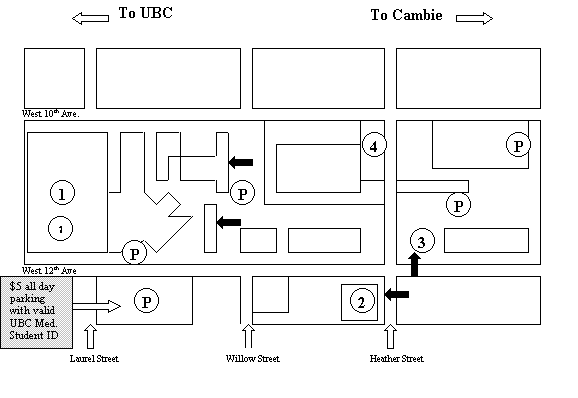
1. Jim Pattison Pavilion (North and South):
~ Through main entrance on West 12th is Café Ami, meeting point for evening CHIUS shifts.
~ Past Café Ami are the elevators:
- Sassafras Food Fair on Floor 2 (cafeteria and microwaves!)
- Dean’s Office and additional clinical skills sites on Floor 3
2. Nurses Residence: 2851 Heather Street (on corner of Heather and West 12th)
~ where most of your clinical skills sessions will be.
3. MSAC: on corner of Heather and West 12th
~ site of many events and Health Sciences Bookstore
4. B Lecture Hall (up the stairs and first door on your right).